
FICTION
NOT ANOTHER BANNED BOOK by Dana Alison Levy / ages 10 -12
Molly is a grade eight student who is grieving over the death of her older brother. Being a member of Ms. Lewiston’s Book Club (LBC) brings her comfort through weekly meetings that allow her and her friends to talk about books. Early in the novel, Ms Lewiston is approached by the principal of the school who informs her that she is being suspended and that the book club needs to come to an end because of books that have been discussed that are ‘not appropriate’ for young readers. . Molly and her friends take action to investigate why this has happened and fight back to fight for the freedom to read. Stories like this are so important, especially in current times, helping young people to consider injustices and find the truth about book challenges, censorship and banning. Dana Alison Levy tells a compelling, serious, and even humourous story about middle years students standing up for what is right.
THE NEVERENDING BOOK by Naoki Matayoshi; illus. Shinsuke Yoshitake, translated from the Japanese by Kendall Heitzman / illustrated story/ 2026
This book cover caught my attention while perusing displays at a bookstore. A story about the pursuit of books intrigued me. That it was a bestselling title in Japan added to the intrigue. The premise starts off well: a very old king who adoress books challenges two characters off on a quest to wander the world in pursuit to find the strangest books that are being read. The subsequent pages is a brainstorming list of quirky books. The books they discover over thirteen nights provdies a list of absurd and somewhat amusing themes: ‘This is the one book that chose its people’; ‘There was one book that had a loud booming laugh.’; ‘There was one book hat was like a cat if you dropped it from a tall place.’ Then the book shifts into a lengthy narrative about two kids, each talented artists, who are determined to create a great book. I lost interest. his book was a disappointment and even though somewhat short (with lots of black and white sketch illustrations), it was neverending for me. I skipped several sections For me, the book was certainly ‘lost in translation.’ This is the first book in many years that I will be returning to the book store. Oh well.
THE READING LIST by Sara Nisha Adams / 2021
I often introduce the literature courses I teach with an activity that invites participants to list any book titles that have been important to them in their lives. I have a handout entitled ‘The Book Shelf of My Life” where people are invited to record books – of any genre – that they would consider to be significant. What picture books, novels, poetry, nonfiction academic titles would be on your list?
The Reading List is a wonderful heartwarming story about how books come into our lives and give significance to our lives. The book is centred on Mukesh, a widower, who leads a quiet life in West London. He his bereft after the passing of his dear wife and regrets not having participated in her life as a reader. His three daughters are hoping that he will ‘move on’ and gain some independence in his life. Hoping to forge a relationship with his granddaughter who is an avid reader, Mukesh makes visit to the library and connects with Aleisha a somewhat troubled teenager who is working at the library for the summer. Aleisha’s life is rather stressful. She is no longer part of the social circle she once was and She and her brother Aidan need to balance their schedules in order to take care of their mother who is experiencing mental health issues. At the centre of the book is a mysterious list of novels that spurs Aleisha to investigate and read. The books offer Aleisha comfort and connections which she passes on to Mukesh. (“The books fill the space where there had once been silence.” The reading list circulates amongst others in the community and each comes to discover how books can help to provide reflection, comfort and joy. (“Please try to remember that books aren’t always an escape; sometimes books teach us things. They show us the world: they don’t hide it.” (p, 319); “Books alway change as the person who reads them changes too.” (p 325)
In this debut novel, Sara Nisha Adams celebrates the magic and power of reading fiction for both readers who consider themselves to be avid readers and for those who may grow into the reading habit. You might know (have read) the books on the list but Adams does a fine job of providing a synopsis of the book and capturing the significance of the theme to those who choose to read the books. The Reading List may inspire readers to check out some of those titles, or consider their own personal lists to share with others. This book was recommended to me by a good friend. Isn’t it great to have good books recommended to you by good friends. Isn’t it great to read a good book about good books and those who love to read? 4 stars
The Reading List that frames this story features the following titles “Just in case you need it.”
To Kill A Mockingbird
Rebecca
The Kite Runner
Life of Pi
Pride and Prejudice
Little Women
Beloved
A Suitable Boy
NONFICTION
THE GIFTS OF READING FOR THE NEXT GENERATION: Essays on Nurturing a Passion for Reading, inspired by Robert Macfarlane and curated by Jennie Orchard / essays / British / 2025
How could I not buy a book with the title The Gifts of Reading for the Next Generation. What insights could I gain from this collection of 25 essays intended to provide a testament to ‘nurturing a passion for reading’. My work as a classroom teacher, university instructor, workshop presenter and author is centred on supporting teachers to choose and use literature in their classrooms that will hopefully inspire their students to partake in the joy of reading today and tomorrow. Thought the numbers keep changing (downward?), statistics tell us that young people (eight to eighteen) do not enjoy reading in their free time. This is grim news. What can we as teachers promote reading as a pleasurable activity?How can we do it? Promoting good books matters. Sharing our own passion for reading matters. There is no one simple answer but the essays in this book provide food for thought about the importance of books in the lives of authors and help us consider the roles we can play. I did not read these contributions chronologically but four pieces in particular drew my attention: “The Gift of Being Read To” by Horatio Clare, “Picture Reading” by Nicola Davies, “Perchance to Dream” by Michael Morpurgo and “(There Are No) Rules for Reading” by Nikesh Shukla. Tthe following passages serve as thoughtful gems that foster the love of reading in the young people in our lives.
“The National Literacy Trust’s Young Reader’s Program found that children and young people were more likely to read if they had support from role models who read and loved reading, access to books, and a ‘quiet place to read in’.”(Robert Macfarlane, p.3)
“Read the world. It is the most mysterious book of all.” from Ben Okri “Ten and a Half Inclinations” (2022)
“When you read aloud to your partner or your child (children?), the room and the world byeond it seem to still, and the spirits gather to hear the story. Words uttered are more than words heard in the silence of the mind; they are things in the world, and the world responds (Horatio Clare, p., 45)
“… young children may not have much command of language, but their inner lives are complex and epic, with big ideas and emotions shifting like waltzing tectonic plates. I am motivated by wanting to write to that complexity, to honour and acknowledge it. That’s why I love he challenge of writing picture books, writing important big stuff but doing it with little words, carefully placed, accessible to small vocabularies. This doesn’t mean tha these texts are superficial; the right small words can suggest deep rich, hinterland that opens under the gaze of a child and is expanded, deepened and set alight by the pairing of words with illustration.”(Nicola Davies, p. 57)
“We will because of these sgtories, go on learning, wondering, dreaming, and searching for wisdom and truth. And if he search for wisdom and truth and creativity is not at the heart of the education of our children, hen surely we are wasting our tie and ours, and we are most certainly not enriching their lives. That is why stories and storyelling of all kinds should be at the centre stage of education. ” Michael Morpurgo, p. 157)
While preparing to write his essay “The Words Made Flesh”, National Book Award-winning author, Colum McCann (Let the Great World Spin) asked his son, JohnMichael, what sort of books he thought young people should be reading, his son was quick to answer – ‘”whatever the hell they want.” (pp. 8-9)
MAKE BELIEVE: On Telling Stories to Children by Mac Barnett / 2026
Mac Barnett is a bestselling, award-winning author of over 70 picture books. He has recently been honoured with the position of National Ambassador for Young People’s Literature in the United States. Some popular titles illustrated by Jon Klassen include, Sam & Dave Dig a Hole, Extra Yarn, The Shape Trilogy. His latest release, The Future Book illustrated by Shawn Harris is a hoot, sure to bring delight and laughter to readers young and old. The three essays that appear in Make Believe help us understand that children’s literature is ‘not only as an art form worthy of deep study and criticism, but as a portal to the lives of children. In the first essay ‘A Grand Unifying Theory of Children’s Literature’, Barnett describes, explains, defends, celebrates the potential merits of children’s literature that deserves to be considered a highly regarded and significant field of writing. He offers the following definition, “A children’s book is a book written for children.” (p. 6). Get into groups and discuss. ‘Good Books for Bad Children’ is the title of the second essay. The title adopts the words said by he visionary edior Ursula Nordstrom who described her job as making “good books for bad children.” In this section, Barnett honours the work of the great Margaret Wise Brown (Goodnight Moon) and discusses the role that adults play in sharing books with children.Any artwork is a conversation between the audience adn he artist. A children’s book, then, is a conversation between a child and an adult.” (p. 30.). ‘The Secret Door’ is the final essay, the author describes how books were central to his family life and his mission as an author to tap into the minds and imaginations of children through the world of fiction. He writes:
“The sublimity of a sentence or a picture, the thrill of a plot, the intimacy of community with a character – the beauty of a good story adn the truth it contains can shock us into surrendering our certainties. And in that gloriously unsettled moment our sense of the possible is enlarged. Every story is a secret door, an invitation to imagine another world and, by believing so, make it real.” (p. 90)
THE STORIES BEHIND THE STORIES: The Remarkable True Tales Behind Your Favourite Children’s Books by Danielle Higley / 2021
This publication is a wondrous treat for lovers of children’s literature. The author provides short essays that explain the fascinating behind-the-scenes creations of twenty-nine children’s classics (e.g., Curious George, Roll of Thunder Hear My Cry, Diary of a Wimpy Kid, A Wrinkle in Time.). Author, Danielle Higley’s research and storytelling helps us ‘”o see that our most treasured children’s books weren’t just built on creativiyand imagination – many were born from extraordinary persistence and grit” (Author’s Note). The authors’ biographical information, ‘did you know’ facts , remarkable stories, and wonderful brighty coloured, detailed collage like- illustrations (including some photo imags) make this publication a fascinating, informative celebration of enduring children’s literature we have come to love.
Some Did You Know examples:
Dav Pilkey was a reluctant reader when he was a kid who had (and still has ADHD and dyslexia. Pilkey was 7 years old when he wrote and illustrated his first Captain Underpants book.Unimpressed, his teacheerf ripped Captain Underpants first comic book in half and told the young author that he ‘couldn’t spend the rest of his life making silly books.”
The idea for The Very Hungry Caterpillar came to Eric Carl when he was playing a whole punch, putting holes in a stack of papers. Ethe author/ illustrator’s picture book hero, a hungry caterpillar was originally was a worm named Willy who became very fat at the end of the story. The infamous book ultimately became a story of transformation.
Children’s book editor Ursula Nordstrom offered Maurice Sendak a contract for a book entitled “Where The WIld Horses Are.” For Sendak, this was a problem since he couldn’t draw horses and when Nordstrom asked, “Maurice, what can you draw?” Sendak answered “Things..” Thus was born Where the Wild Things Are.
It’s sort of curious that “Goodnight Cucumber. Goodnight fly” got removed from Margaret Wise Brown’s Goodnight Moon manuscript.
Christopher Paul Curtis took a year off from working on a General Motors assembly line in Flint, Michigan. He hoped to write a book based on a car trip he took with his own family to visit family in Florida. When his sonb gave his father with the poem “The Ballad of Birmingham’ by Dudley Randall, about the chruch bombing. the Watsons’ travelled to Birmingham instead of Florida. and the author wove in events that were inspired from his own life. When he submitted a manuscript for The Watsons Go To Birmingham – 1963 to two contests, he did not win either award but the book caught the attention of a publisher and the book went on to win the Newbery Honor Prize and the Coretta Scott King Award.
EVERYDAY I READ: 53 ways to get closer to books by Hwang Bo-Reum, Translated from the Korean by Shanna Tan
I brush my teeth everyday I read every day Those in schools and businesses certainly read every day. However statistics inform us that the habit of reading for pleasure is declining both for both adults and young people. Research studies claim that daily reading as a primary leisure is declining year by year and fell by 40% in the past twenty years. (Note: data was taken from more than 236 000 Americans who participated in the American Time Use survey. The 2023 study was published in the journal of iScience) .Hwang B0-Reum offers a list of 53 strategies presented as mini essays to help us consider how to move towards a life habit of daily leisure reading, no matter the genre. Sample tips include: Read Bestsellers (1) , You Don’t Have to Finish It (17); Read to Seek Answers (22);Read Widely, Then Deeply (39)Read Book Reviews (42) Write Book Reviews (43); Read Books That Preserve Your Sense of Self (51). Notable too, are book recommendations are blended within each piece. Each essay invites readers to reflect on their reading habit and explore ways to encourage bookloving.
SHOUT OUT
MARILYN AND HER BOOKS: The Literary Life of Marilyn Monroe by Gail Crowther 2026
June 1st, 2026 would have been Marilyn Monroe’s 100the birthday. Her life and work has forever been celebrated and examined before and since her death in . TCM featuring her movies. Two weeks ago I watched Some Like It Hot (the funniest movie ever made, says I) and I watched it again this week. Two new publications about the actress caught my attention, The Last Days of Marilyn Monroe by James Patterson and Imogen Edward Jones and this book by researcher Gail Crowther debunks Monroes dumb blonde reputation by exposing her bookshelves and examines the MarilynMonroe’s life as a reader. . This book analyzes the literary life of the iconic Hollywood actor, delving into her personal collection of multi-genre titles, and the 400+ books from her collection that were sold at Christies’ auction. Crowther describes Monroe’s association with writers, her life of living with a writer, and describes the significance of books on her craft, her intellectual development and her friendships. The book is cleverly framed on intriguing questions that are answered in each chapter. Did Marilyn read all her books? Did Marilyn’s reading link to her acting? Why is Marilyn’s reading ability doubted? Did Marilyn suffer from imposter syndrome?
It is believed that Marilyn spent so much of her free time reading, always having a book on the go when she was on film sets. She spent time in book stores, was gifted books and was surrounded by books in her homes (she always took her books with her whenever she moved.) She read widely. The books that are featured in the endpages provide a glimpse of her interests (e.g., The Joy of Cooking, From Russia With Love, Of Human Bondage, On the Road, The Sun Also Rises, Napolean). Note A list of Marilyn’s personal library, by genre, of the 400 book presented in Christie’s Catalogue, 1999 is featured in an appendix to the book. In one of the final chapters, recognition is given to the picture book The Little Engine that Could by Wally Piper (1930), a book Marilyn owned since childhood. The heme of bravery optimism and hard work serves as a symbol of the “I think I can.., I think I can…” mantra that Monroe lived with.
Novelist, Walter Mosley once claimed, “you can learn everything you need to know about a person by looking at their bookshelves.”Thorough research and recounts of events in Monroe’s life that were centred on books, books books, Gail Crowther uncovers Monroes bookshelves painting a vivid picture of her literary journey, her identity and her legacy This title is certain to be listed as one of my favourites at year’s end. What an astonishing, complex, misunderstood, dynamic, talented, smart woman Marilyn Monroe was. What an astonishing document Marilyn and Her Books is!
Excerpt
“What is forming here is a picture of Marilyn as reader, writer, and critic. Her lack of formal education perhaps excludes her from being regarded as a traditional intellectual. And her lack of social and cultural capital, combined with her studio-created sexpot image, did nothing but cement the myth of her as ‘the dumb blonde’. But myths are not facts, they are usually socially constructed, and anything that is constructed can be changed. Marilyn was misunderstood and spent much of her life engaged in intellectual pursuits. This is another reason why she needs to be recast and reimagined: not the late, not the ditzy, not the bombshell, not the difficult, but the intelligent Marilyn Monroe. (p. 229-230)
PICTURE BOOKS
ALONG CAME AN AARDVARK by Vi Hughes; illus. Lydia Ramsey / Plumleaf Press/ 2026
The hero of this story is Sam O. Dictionary who seems to be a forgotten book on the library bookshelf. When Sam overhears nursery rhymes being recited during library storytime he’s nystified by such snonsense as ‘mittens with kittens’m Humpty Dumpty falling off the wall,. Sam cleverly thinks of a plan to ‘use his words’ and to lure others to take notice of him and the importance of discovering the meaning and importance of words, words, words. This amusing story is a celebration of words as well as a celebration of nursery rhymes. Along Came An Aardvark may invite young readers to ‘use’ the dictionary and think about the words and stories of Mother Goose. Note; The end pages featuring an A-z list of familiar and unfamiliar vocabulary is a bonus treat to this publication.
BOOKS MAKE GOOD FRIENDS by Jane Mount / 2023
Shy Lotti is reluctant to make new friends.LottiLOVES books and finding a quiet place to read brings her comfort and joy. Books stir the imagination. Books can take us to faraway places. Books make good friends. The books that Lottie discovers in library visits help her to gain confidence and ultimaely find new friends. This autobiographical story, this picture book is a book lovers delight, a book for avid readers and those who are growing to discover the magic of reading. The abundant inclusion of illustrated images of book spines offer a rich trove of treasured book titles. The journal-esque narrative along with the abundant recommended book titles help to make this a super book about discovering the self, discovering friends and discovering great books.
Noteworthy, The 50 or so spine images with picture book and novel titles featured is a compendium of old and new great book to that book lovers may recognize (e.g., Goodnight Moon by Margaret Wise Brown, I Want My Hat Back by Jon Klassen, We Are in a Book by Mo Willems, If You Come to Earth by Sophie Blackall, Beezus and Ramona by Beverly Cleary, Pax by Sara Pennypacker, Smile by Raina Telgemeir, The Crossover by Kwame Alexander. What are some of your favourite good friend literature pieces you’d reference on a cover on this picture book?
A CHILD OF BOOKS by Oliver Jeffers and Sam Winston / 2016
The opening spread of this book reads: “I am a child of books. I come from a world of stories.” The girl is joined by a boy embark on a journey to experience a journey, across “a sea of words” through forests of fairy tales and mountains of make-believe. This book inspires readers to think about the power of imagination – “for imagination is free’ – and how they might see themselves in stories. Any book that helps readers to reflect upon the rewards of reading and the importance of sharing stories is worth sharing. A Child of Books is one of those very special books that is a love letter to reading, a mighty fine tribute to books.
Bonus: The opening 2-page spread of this book, lists , in tiny font, over 200 literature titles. How many have you read?
I WILL JUDGE YOU BY YOUR BOOKSHELF by Grant Snider / graphic nonfiction / 2020
I love books. The title of this book and the peek-a-boo image on the cover caught my attention. In this book, comic artist, Grant Snider has given a testimony to the importance of books in our lives. In one or two pages, Grant Snider presents a range of topics (Stages of the Reader, A Writer’s Routine, Understanding Poetry, Ban This Book, Reader’s Block), through a range of genre (poetry, advice, anecdote, list, exposition, Grant Snider is very clever with words, terrific at brainstorming, a great graphic artist, He is insightful, witty, wise and hooray, hooray, he loves books This is a book lover’s book. I loved it.
Sample (alas, without visual images) / Perfect Reading Spots
Overstuffed chair, Morning sunbeam, Rush-hour traffic, Unusual trees, Yoga Class, Business Lunch, On the Beach, On he bus, Bookshop window, Attic crawl space, Secret Library Corner, Lover’s Embrace, Frustrating Hammock, Comfortable bed, Alone with my thoughts;, Ouside my own head.
SHOUT OUT
TED TALK: Ann Patchett (14 min. 54 sec)
THE LOVE OF MY LIFE (AND WHY I NEED TO SHARE IT WITH YOU)
Acclaimed author Ann Patchett (Bel Canto, The Dutch House, Tom Lake, Whistler) shares her passion for reading in this Ted Talk. She notes that reading is not just a private pleasure but has the potential to pull readers out of isolation and build empathy. Patchett urges her audience to be part of a society that cultivates readers for today and tomorrow.
>>>>>>>>>>>>>>>>>>. SHOUT OUT. <<<<<<<<<<<<<<<<<<<<
PROFESSIONAL TITLE
YES, GENRE MAKES A DIFFERENCE by Larry Swartz
Pembroke Publishers, 2026
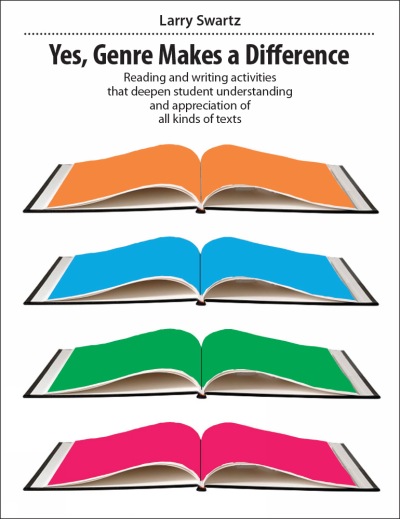
The opening statement to my new book reads: “Perhaps the epitaph on my tombstone will read Good Books Matter on one side and Read Anything Good Lately on the other. For the past 50 years as a classroom, teacher, university instructor, consultant, conference speaker and uncle, i have been passionate about sharing literature with people young and old. This new publication is designed to help teachers introduce students toall genre forms as they build skills in reading and writing. This resource can be considered the ultimate guide to choosing and using books to actively turn kids on to reading by exploring picture books, novels, nonfiction and poetry. I offer comprehensive lists of books and present over 150 ready-to-use activities (including reproducibles that will inspire students to experience and respond to literature. Ultimately, my goal is to provide information and techniques to deepen understanding and appreciation of all kinds of texts. Leading Literacy educator, Regie Routman, author of The Heart-Centred Teacher writes; “You can’t make a great fruit tart from a second-rate fruit, just as you can’t teach reading well without first-rate literature.” Yes, Genre Makes a Difference is intended to inspire, guide, motivate and have teachers consider that Good Books Matter.